Some crystals are durable and thrive in salt cleansing, while others are too soft, porous, or fragile and can be damaged. In this post, I’ll clearly outline crystals that can go in salt and those that cannot, so you can safely recharge your collection without worry!
Salt has been used for centuries as a natural purifier, cleanser, and energy neutralizer.
Just as it absorbs negative vibrations from the environment, it can also draw out stagnant or unwanted energy from crystals.
Some stones thrive in salt cleansing, while others are too soft or delicate and may be damaged.
Before we look at the top crystals that can go in salt and those that cannot, I want to share the different types of salt you can use for crystal cleansing and charging (plus the salts to avoid!):
Top 6 Types of Salt You Can Use for Crystal Cleansing
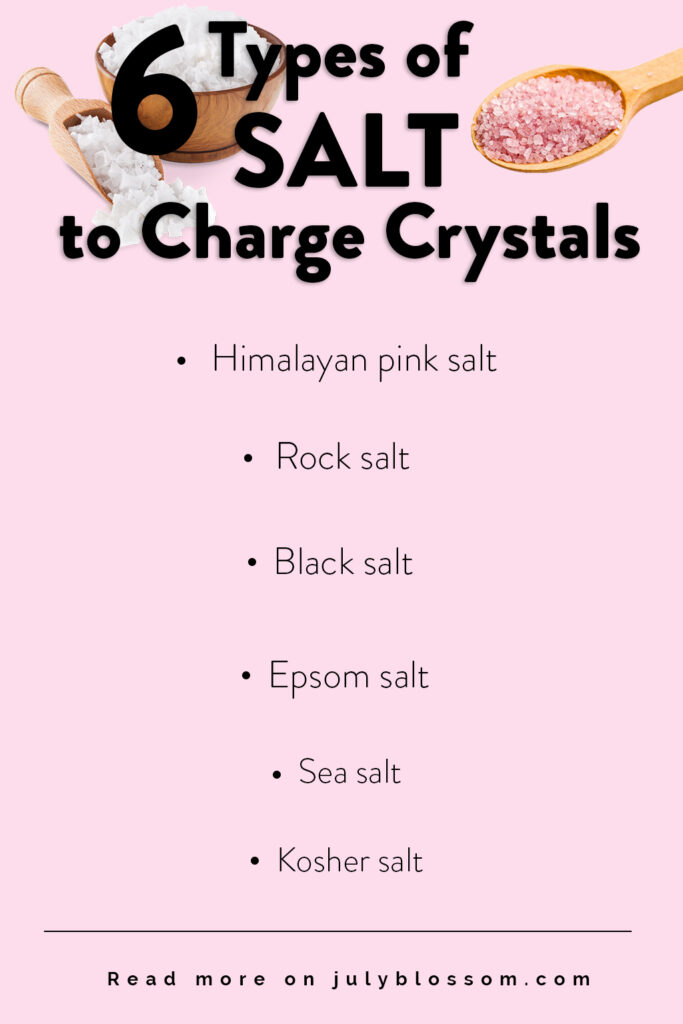
Different types of salt can be used for crystal cleansing, each carrying its own subtle energy. Here’s a breakdown of the most common ones you can use:
1. Sea Salt
Sea salt is the most popular, traditional and widely used salt all over the world. I’m pretty sure you have it in your kitchen right now! Sea salt is also the number one salt used by witches for cleansing. It is associated with purification, renewal, and the cleansing power of the ocean.
It is best used dry (in a bowl) rather than dissolved in water unless your crystal is water-safe.
2. Himalayan Pink Salt
Himalayan pink salt is such a pretty type of salt in witchery! It is known for its gentle, soothing energy.
Pink salt is excellent for cleansing crystals associated with love, peace, and emotional healing (like rose quartz, amethyst).
It can also be used in lamp form for indirect energy cleansing.
3. Rock Salt
Rock salt is a strong purifying salt often used in Indian traditions for cleansing energy and warding off negativity.
Its coarse texture makes it perfect for creating protective circles around crystals (without direct contact).
4. Epsom Salt
Technically magnesium sulfate, not true salt, Epsom salt can still used for crystal cleansing.
It is best for energetic purification baths (for yourself and indirect cleansing for crystals).
Don’t soak crystals directly in it but rather, just use it nearby in a cleansing ritual.
5. Kosher Salt
Kosher salt is pure, additive-free, and coarse-grained.
It’s great for dry salt bowl cleansing or creating salt circles.
6. Black Salt (Protective Salt)
Black salt, also known as witche’s salt, is a mix of salt, charcoal, ash, or herbs used in metaphysical practices.
It is best for protection, banishing, and removing heavy or negative energy.
Use around crystals (in a circle or nearby), not directly on delicate ones.
Here’s my article on How to Make Black Salt!
❌ Salts to Avoid Directly on Crystals
• Table Salt (Iodized Salt) – Contains additives and chemicals that can leave residues.
• Flavored or Infused Salts – Oils, herbs, or dyes can stain or damage crystals.
✨ Pro Tip: If you’re ever unsure whether a crystal is safe for direct salt contact, place it in a small glass dish and then rest that dish in the salt (indirect cleansing). That way, you still benefit from the salt’s energy without risking damage!
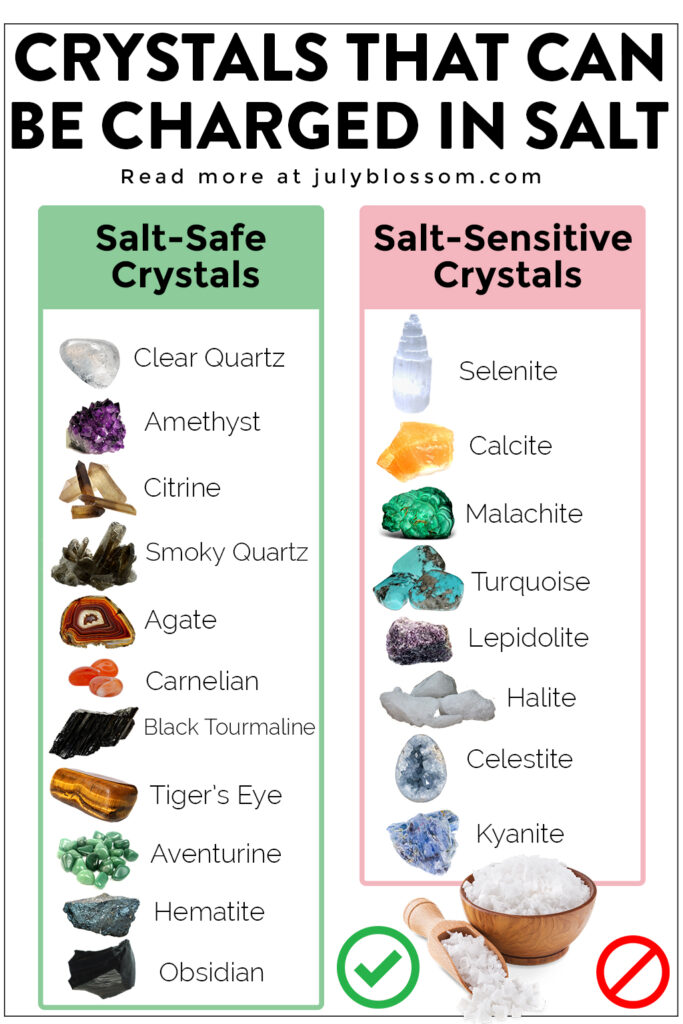
✅ Top 12 Crystals That Can Safely Be Charged in Salt
These are hard, durable stones that won’t be harmed by dry salt.
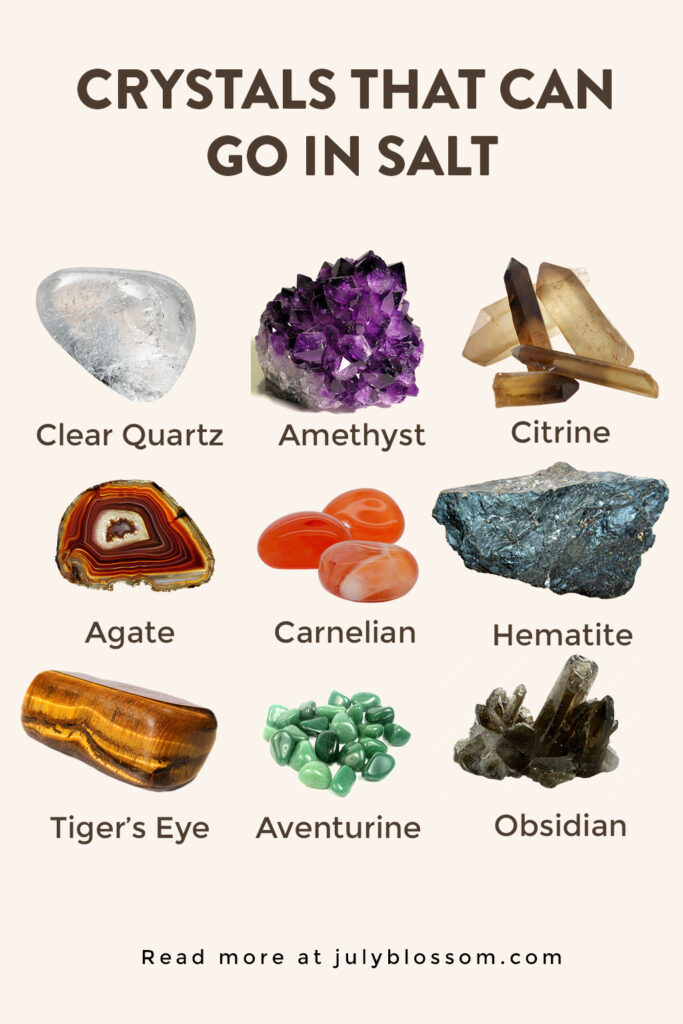
1. Clear Quartz
Tough and resilient, it happily absorbs the cleansing energy of salt.
2. Amethyst
A sturdy member of the quartz family; great for salt cleansing (dry, not water + salt).
3. Rose Quartz
Durable enough to handle dry salt charging but avoid salt water, since prolonged exposure to moisture plus salt can damage the crystal’s surface or dull its polish.
4. Citrine
Both natural and heat-treated varieties can sit safely in salt.
5. Smoky Quartz
Beneficial to release absorbed negativity into salt.
6. Agate
Durable and stable, making it safe for dry salt charging.
7. Carnelian
Hard and strong enough to withstand salt contact.
8. Aventurine
A member of the quartz family, it can rest safely in dry salt.
9. Tiger’s Eye
Strong, fibrous quartz; salt won’t harm it.
10. Black Tourmaline
A protective stone that benefits from salt’s purifying qualities.
11. Hematite
Naturally linked with grounding; it can be safely placed in salt.
12. Obsidian
Volcanic glass, very durable and safe for salt cleansing.
✨ Pro Tip: Always use dry salt, not salt water, unless you are certain the crystal is water-safe.
❌ Top 8 Crystals That Should NOT Be Put in Salt
Some crystals are soft, porous, or layered, which means that salt can scratch, weaken, or dull them!
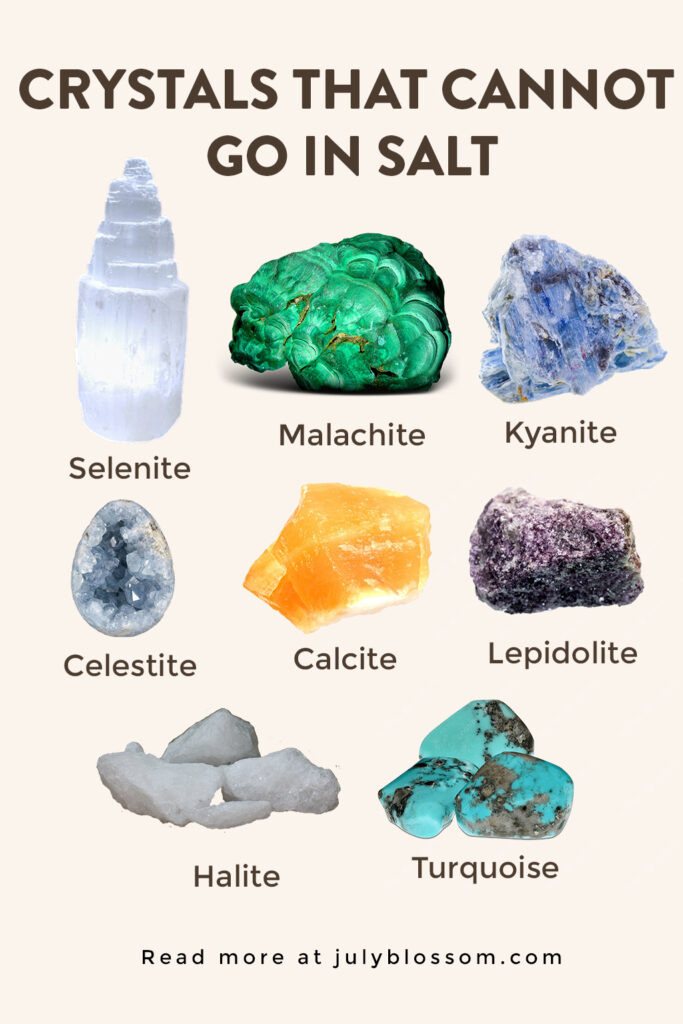
1. Selenite
Very soft (Mohs 2); it scratches and dissolves easily.
2. Calcite
Soft and easily damaged by abrasion.
3. Malachite
Porous and often polished with coatings; salt can ruin the surface.
4. Turquoise
Porous and delicate, best kept away from salt.
5. Lepidolite
Flaky and soft; salt will damage its surface.
6. Halite
A natural form of salt which dissolves in contact with salt or water.
7. Celestite
Fragile and prone to crumbling.
8. Kyanite
Though somewhat tough, its striations make it unsuitable for salt.
3 Alternative Salt Charging Methods
If you’re worried about scratches or damage but still want to use salt:
- Salt Bowl Barrier: Place the crystal in a small dish, then place that dish inside a larger bowl of salt so the energy is absorbed without direct contact.
- Salt Circle: Surround the crystal with a ring of salt rather than burying it.
- Salt Lamps: Himalayan salt lamps provide a gentle cleansing energy without abrasion. Place your crystals near a lit salt lamp. Make sure the lamp doesn’t sweat and drip near your crystals by placing them at a reasonable distance and keeping a cloth under your salt lamp.
Salt is one of the most powerful natural purifiers, but it’s not suitable for every crystal. This article entitled, ‘Crystals that Can Go in Salt and those that Cannot’ will help you keep your collection vibrant, strong, and free of physical damage.


Leave a Reply